When I organised the Orlando IoT Meetup group in Orlando, Florida for a few years, I realised that the value that people coming to the events was about 20% what the speaker taught them and about 80% talking with other like-minded people.
Unfortunately, that’s not how I structured the time – I often structured the meetups where 100% of the time was for talks and if anyone wanted to chat they could do so before or after when we went to the bar, which about half the group did.
In the moment, it wasn’t too important what people talked about, either. It could have been about Raspberry Pi hats or Arduino doohikeys. At any given meetup, the subject of conversation was trivial.
What mattered is that people who had been traveling alone had found their tribe, and realised that they weren’t alone, and that they could lean one on another to keep going down the path. As meetup after meetup happened, people did more than swap ideas and war stories. They connected. They guided each other. They became friends, co-founders, and colleagues. I don’t know all of their stories and can’t know, but I know that the butterfly effects of those meetups was far more influential than the meetups themselves.
What I had thought was a meetup where people came to learn from speakers talking about a subject, which is why many people consciously came, was really about something else. It was about connection and community and shared purpose.
My Journey With AI
Last year I graduated with an Artificial Intelligence Master’s degree from the University of Galway while increasingly incorporating AI into my daily full-time job as a software engineer. At one point, I had 80+ agents running simultaneously.
That didn’t work that well.
In fact, many of the things I tried my hand at regarding AI didn’t work that well. But a few did, and then a few more, and then I started to get productive with it. That’s how it goes.
In parallel, all across the world, many other people have started doing it too. In a short few years we went from AI helping complete code you were already writing to the ability to write 90% or more of it. That’s not figurative, that’s literal.
Now we have different problems to solve other than writing code. What about security? What about institutional knowledge? Is there a danger of skill atrophy? Why do the Pull Requests keep piling up?
I hardly have all the answers. But I know one answer, and it’s a big one:
We need each other. There are swaths of people out there who are interested in this, have been working with it, have figured out so much, but haven’t figured out everything. They are bursting to share what they know and are thirsty to learn more. And we need each other to grow and learn.
The Antislop Workshops
The older I get, the more I realise the limitations of traditional ideas about what we call ‘learning’. Or perhaps not simply traditional, but widely accepted.
You know that I don’t believe that anyone has ever taught anything to anyone. I question that efficacy of teaching. The only thing that I know is that anyone who wants to learn will learn. And maybe a teacher is a facilitator, a person who puts things down and shows people how exciting and wonderful it is and asks them to eat.
Carl R. Rogers
Carl R. Rogers is a psychologist and author, and perhaps this is his most controversial opinion. We don’t teach others, we can’t teach others. We can only guide them in and show them what they could learn.
My partner, Dr. Sarah Porcenaluk, has a doctorate in education, and unbelievably agrees with Carl Rogers to some extent. What she has known to work in education, from the research and first-hand experience as an educator for more than a decade, is that hands-on learning where critical thinking skills are applied sticks.
So I’ve designed a curriculum, if you can call it that, designed around these principles. I don’t hold all the knowledge, and even if I did, simply sharing it traditional-classroom-style wouldn’t mean much. I want to get people sharing their own knowledge, forming connections, forming community, and leaving inspired to keep learning outside the bounds of the workshops.
Given a long enough time horizon, what you learn in the workshops should round to 0% of your knowledge on the subject of how AI can help you as a software engineer.
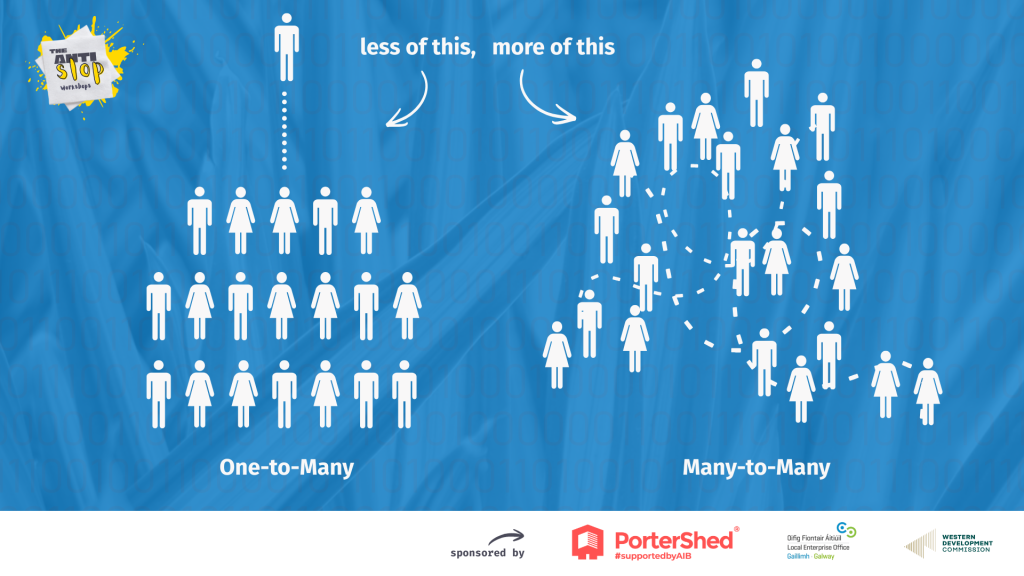
If you come to the workshops, expect it to be more like the many-to-many diagram on the right for most of the time. I will be sharing a bit of context and framing, but hopefully to provide just enough to give a grounding for the more interactive and collaborative bits.
I can’t know what all you’ll learn. You’ll probably learn more from your peers than from me. You’ll probably learn more from your own exploration within the workshops, and hopefully beyond them, than from me. I won’t know all you’ll learn, but my sincere hope is that you’ll learn more than I know and that you’ll form community with like-minded people.
If that sounds exciting, or at least somewhat interesting, have I got a workshop series for you.